

Product Info
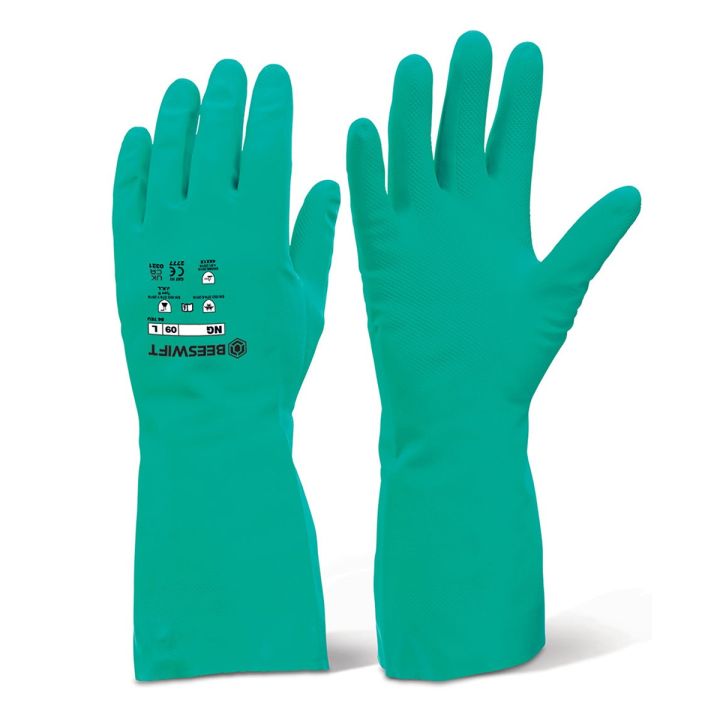
- Nitrile glove
- Flocklined
- Overall length 31.5cm
- A high level of resistance to abrasion, solvents and animal fats.
- Embossed pattern to palm
- Silicon and wax free
- [H3]
Certification
- s[/H3]
- EN388:2016+A1:2018Level 4 – Abrasion Resistance
- Level 1 – Blade Cut Resistance
- Level 0 – Tear Resistance
- Level 1 – Puncture
- Level X – ISO 13997 Blade Cut Resistance
- EN ISO 374-5:2016Level Pass –
Protection
- against bacteria and fungi
- Level Pass –
Protection
against viruses
EN ISO 374-1:2016+A1:2018/TYPE ALevel 6 – n-Heptane (J)Level 6 – 40% Sodium Hydroxide (K)Level 3 – 96% Sulphuric acid (L)Level 5 – 25% Ammonium Hydroxide (O)Level 6 – 30% Hydrogen Peroxide (P)Level 6 – 37% Formaldehyde (T)ISO 18889:2019Level G2
Protection
against liquid pesticides
EN ISO 374-1:2016+A1:2018 – Protective gloves against dangerous chemicals and micro-organisms. Terminology and performance requirements for chemical risks
- J: n-Heptane 6: above 480 minutes
- K: 40% Sodium Hydroxide 6: above 480 minutes
- L: 96% Sulphuric Acid 3: 60 – 119 minutes
- O: 25% Ammonium Hydroxide 5: 240 – 479 minutes
- P: 30% Hydrogen Peroxide 6: above 480 minutes
- T: 37% Formaldehyde 6: above 480 minutes
- EN ISO 374-5:2016 – Terminology and performance requirements for micro-organisms risks
- Resistance to Bacteria and Fungi Pass
- Resistance to Virus Pass
- EN 388:2016 +A1: 2018 – Protective gloves against mechanical risks
- Abrasion Resistance 4: High abrasion resistance (8000 cycles)Cut Resistance (Coupe Test) 1: Low Cut Resistance
- Tear Resistance 0: Did not achieve lowest scores
- Puncture Resistance 1: Low puncture resistance (20N)Cut Resistance (ISO 13997) X: Not tested
EN 374-4:2019 – Determination of resistance to degradation by chemicals(J) n-Heptane Degredation 5.1 %(K) Sodium Hydroxide 40% Degredation -13.3 %(L) Sulfuric Acid 96% Degredation 61.8 %{O} Ammonium Hydroxide 25% Degredation -5.9 %(P) Hydrogen Peroxide 30% Degredation -5.2(T) Formaldehyde 37% Degredation -3.0 %

Reviews
There are no reviews yet.